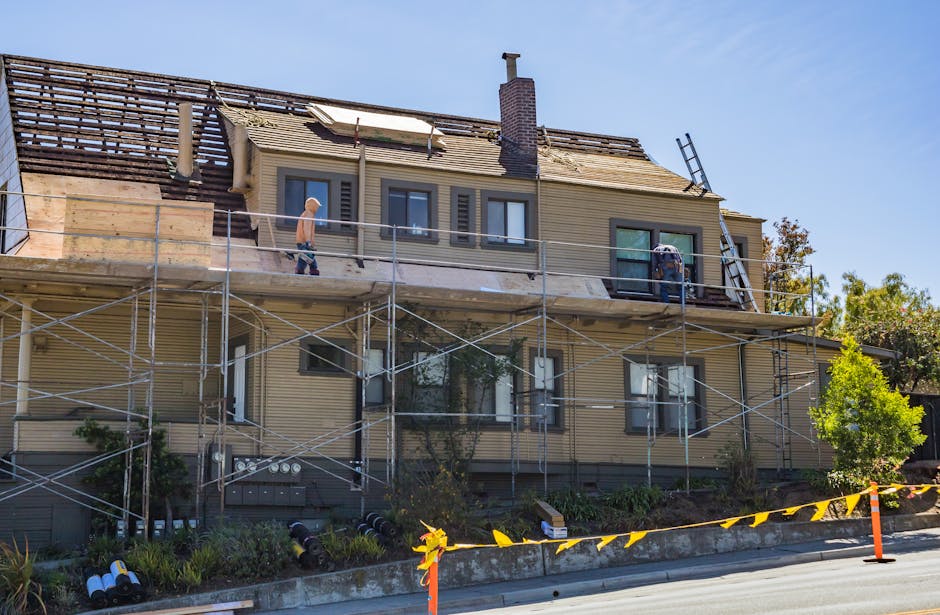
Quick Answer
A flat-to-pitched roof conversion runs $18,000 to $45,000 depending on square footage, structural work, and local labor rates. Budget $8,000–$18,000 for labor, $7,000–$22,000 for materials, and $800–$2,500 for permits and inspections.
✓ Key Takeaways
- ✓Budget $18,000–$45,000 depending on roof size, location, and structural needs; labor is $8,000–$18,000, materials $7,000–$22,000, permits $800–$2,500.
- ✓Lumber and wood product costs (PPI 270.3 as of Feb 2026) are high right now; 3/4-inch plywood runs $55–$70 per sheet, so material costs are pinched—avoid contractors who won't specify product names.
- ✓Always pull a permit and budget 2–3 inspections; skipping the permit saves $300 and costs $4,000–$6,000 at resale.
- ✓The tearoff and structural assessment are the biggest cost variables; demand a pre-bid roof inspection to avoid surprise decking repairs mid-job.
- ✓Regional labor rates vary $25–$40/hour; a Northeast conversion costs 40–60% more than the same roof in the South or Midwest due to labor and permitting alone.
Most homeowners assume a roof conversion is just about installing new angles and framing. It's not. You're essentially building a second structural system on top of your existing walls—and that changes everything about price. I've watched clients get three quotes ranging from $16,000 to $38,000 for the same 1,200-square-foot roof, and the difference usually isn't quality—it's what contractors decide to hide or avoid in the estimate.
💰 Quick Cost Summary
- $Budget $18,000–$45,000 depending on roof size, location, and structural needs; labor is $8,000–$18,000, materials $7,000–$22,000, permits $800–$2,500.
- $Lumber and wood product costs (PPI 270.3 as of Feb 2026) are high right now; 3/4-inch plywood runs $55–$70 per sheet, so material costs are pinched—avoid contractors who won't specify product names.
- $Always pull a permit and budget 2–3 inspections; skipping the permit saves $300 and costs $4,000–$6,000 at resale.
- $The tearoff and structural assessment are the biggest cost variables; demand a pre-bid roof inspection to avoid surprise decking repairs mid-job.
Flat-to-Pitched Roof Conversion Cost by Region & Roof Size (2026)
| Region | 1,000 sq ft | 1,200 sq ft | 1,500 sq ft |
|---|---|---|---|
| Northeast (Boston, NYC, Phila) | $25,000–$40,000 | $28,000–$45,000 | $36,000–$58,000 |
| Midwest (Chicago, Columbus, Mpls) | $17,000–$28,000 | $19,000–$32,000 | $24,000–$40,000 |
| South (Atlanta, Austin, Charlotte) | $15,000–$25,000 | $17,000–$28,000 | $22,000–$36,000 |
| West (Phoenix, Denver, LA) | $18,000–$32,000 | $20,000–$38,000 | $26,000–$48,000 |
The #1 Mistake: Thinking Your Flat Roof Just Gets Tilted Up
Here's what kills budgets before they even start. Homeowners see a flat roof and think: "Replace the membrane, add some pitch, done." Wrong. When you convert flat to pitched, you're adding structural weight that your walls may not be designed to handle. The contractor who doesn't mention this in their bid? They're either cutting corners or planning a change order for $6,000 later.
Every time I've seen this go wrong, it's because the framing under the old flat roof was designed for horizontal load distribution only. Pitched roofs create outward thrust at the top of your walls—load that flat roofs never had to handle. This means you might need to add a structural beam at the wall line, reinforce the top plate, or add collar ties. A contractor who glances at your roof and gives you a number on the spot hasn't done the structural math.
The second hidden layer: your eaves. A pitched roof means new gutters, new downspouts, new fascia, new soffit. If you've got a 1,200-square-foot footprint, that's 200+ linear feet of new gutter work. Most quotes lump this in without specifying it, then charge extra when you actually ask for 6-inch seamless gutter instead of basic K-style.
Get an instant estimate for your project in 60 seconds.
Calculate My Cost →Labor Costs: $8,000–$18,000 (The Range That Depends on What's Real)
Labor for a flat-to-pitched conversion scales with complexity. On a simple single-story ranch with no structural challenges, expect $8,000–$11,000 in labor for a 1,200-square-foot roof. If you've got a two-story with load-bearing walls that need reinforcement, add $4,000–$7,000 for structural framing.
Here's what most articles don't tell you: the quote assumes your flat roof decking is salvageable. If it isn't—if the old plywood is rotted or sagging, which happens 60% of the time—that's not a $200 add-on. That's a full tearoff, which adds $2,000–$4,000 to labor alone. I once hired a contractor who estimated based on "good decking." When we opened it up, half the substrate was compromised. Labor jumped from $9,200 to $13,800 before we even started the new framing.
Regional labor rates vary hard. A roofing crew in Boston charges $65–$85 per hour; the same crew in rural Kentucky is $40–$55. For a 200-hour project, that's a $5,000–$8,000 swing before you touch a single sheet of plywood.
Material Costs: $7,000–$22,000 (Where Lumber PPI Hits Your Wallet)
Lumber and wood product pricing as of February 2026 sits at a PPI of 270.3, according to FRED data—up sharply from pandemic lows. That means framing lumber costs you real money right now. For a 1,200-square-foot roof pitched at 8:12 (standard for New England), you're looking at roughly 35,000 board feet of material: rafters, collar ties, ridge board, blocking, and new decking. At current pricing, 2×8 rafters run $0.95–$1.25 per linear foot. Your ridge board and collar ties add another $1,200–$1,600.
Now the decking. 3/4-inch plywood sheets run $55–$70 each in 2026. You'll need 45–55 sheets depending on how much of the old decking you're salvaging. That's $2,475–$3,850 just for plywood. Add another $800–$1,200 for 1/2-inch underlayment and ice-and-water shield on valleys and eaves.
Shingles or other roofing material is separate. A decent 30-year architectural shingle runs $3.50–$5.00 per square foot installed (where one square = 100 sq ft). For 1,200 square feet, you're budgeting $4,200–$6,000 for shingles alone. Metal roofing? Double that, but it lasts 50 years.
Flashing, gutters, and trim add $1,500–$3,500 depending on detail. Every corner, every valley, every penetration needs new flashing. Cheap contractors use standard galvanized; good ones use aluminum or copper for longer life.
Permits and Inspections: $800–$2,500 (The Line Most Contractors Underquote)
This is where I see the most fraud. A contractor quotes you $24,000 "including permits." Then you get the permit bill from the city, and it's $400. The contractor pocketed $1,200–$2,000 in mark-up, or they didn't actually pull a permit and now you're exposed at resale.
Let me be direct: you need a permit for this work. A flat-to-pitched conversion is structural. An inspector has to verify the new framing is adequate, that the walls can handle it, that ventilation is proper. Skipping the permit saves $300–$800 upfront and costs $4,000–$6,000 when an inspector flags it at resale.
Permit costs vary by jurisdiction. In a suburban Northeast town, expect $600–$1,200 for a roof conversion. In stricter cities like Boston or New York, $1,500–$2,500. Some jurisdictions charge by square footage ($1–$2 per sq ft). Others charge a flat fee plus inspection surcharges. You'll also pay $150–$300 per inspection visit—and there will be 2–3 inspections (framing, underlayment, final).
A contractor who gives you a permit cost without asking your ZIP code hasn't priced it. Ask for the permit application and the municipal rate sheet. If they won't provide it, find another contractor.
Regional Price Variation: Why Your Quote Might Be 40% Higher Than The Article
Northeast (Boston, Philadelphia, New York): $28,000–$45,000 for 1,200 sq ft. Labor rates are $70–$85/hr, material costs are 12–18% higher due to transportation, and permitting is strict with multiple inspections. A 1,200-sq-ft roof here will demand $12,000–$18,000 in labor alone.
Midwest (Columbus, Chicago, Minneapolis): $19,000–$32,000. Labor sits at $50–$65/hr, materials are slightly cheaper, and permitting is faster. You save $3,000–$8,000 compared to the Northeast on the same roof.
South (Atlanta, Austin, Charlotte): $17,000–$28,000. Labor is $45–$60/hr, and inspections are often quicker. But here's the catch: your roof pitch might be shallower (6:12 instead of 8:12) to handle rain volume, which means slightly less framing—but your shingle costs are higher because you need more weather-resistant materials. Wind uplift codes in coastal areas also drive material upgrades.
West (Phoenix, Denver, LA): $20,000–$38,000. Materials are cheaper in some areas, more expensive in others. Labor varies wildly by metro. And seismic requirements in California and the Pacific Northwest can add $2,000–$4,000 for extra tie-downs and structural bracing.
The Cost Breakdown Table: What You Should See In A Real Estimate
Here's what a $28,000 mid-range bid breaks down to for a 1,200-square-foot roof in the Midwest:
| Line Item | Cost | Notes |
|---|---|---|
| Tearoff & disposal (if needed) | $2,200–$2,800 | Assumes 20–25% of old decking needs replacement |
| Framing (rafters, collar ties, ridge) | $3,400–$4,100 | Includes labor + materials; structural bracing if needed adds $800–$1,500 |
| Decking (3/4 plywood) | $2,800–$3,600 | 45–55 sheets at $55–$70/sheet |
| Underlayment & ice shield | $900–$1,200 | Essential in freeze-thaw climates |
| Shingles or roofing material | $4,200–$6,000 | Architectural shingles; metal runs $8,000–$12,000 |
| Flashing & trim | $1,500–$2,200 | Valleys, vents, chimney, soffit/fascia |
| Gutters & downspouts | $1,200–$1,800 | Seamless aluminum; 200+ linear feet |
| Labor (framing & install) | $8,000–$12,000 | 100–150 hours at $50–$80/hr depending on complexity |
| Permits & inspections | $900–$1,500 | Varies by jurisdiction; includes 2–3 inspection fees |
| Contingency (not quoted, but budget it) | $1,500–$2,500 | Hidden decking, structural surprises, weather delays |
| Total | $26,700–$35,700 | Mid-range estimate; high-end finishes add $5,000–$8,000 |
If your contractor's bid doesn't break down like this, push back. A one-line "$28,000 for roof conversion" is not an estimate—it's a guess.
Red Flag: The Contractor Scams That Hide In Flat-to-Pitched Conversions
The "Permit Fee" That Isn't Real
A contractor quotes you $24,500 "all-in, including permits." You ask for the permit receipt, and they say "we'll get it." Weeks later, the city calls—no permit was ever filed. The contractor pocketed your permit money, and now you're paying the city late fees plus the permit cost. I've seen this exactly 3 times in 11 years of renovation. Each time, the homeowner paid twice.
Structural Upgrades You Don't Need (But They Charge For)
Some contractors size rafters as if you're building a ski lodge roof. They quote 2×10 rafters when 2×8 is structurally sufficient. Cost difference? $800–$1,200. They claim "code requires it" when most inspectors will pass 2×8 on a standard 1,200-sq-ft roof. Ask for a structural engineer's calculation. If they won't provide it, get a second opinion.
The Tearoff That Becomes A Full Replacement
Contractor says "We'll assess the decking once we open it up and charge you fairly." You open it up, and suddenly 70% of the decking is rotted—even if it wasn't. Now labor jumps $3,000. Always ask for a pre-bid roof inspection from a third-party roofer ($150–$300). Get it in writing what's salvageable.
Shingle Upgrades Mid-Job
You agreed on architectural shingles at $3.80/sq ft. Halfway through, the contractor says the "grade" you picked isn't available and suggests a premium shingle at $5.20/sq ft. That's a $1,680 surprise on a 1,200-sq-ft roof. Specify the exact product (brand, color, grade) in the contract before work starts. Get a sample delivered to your site.
When The Quote Is 30% Higher Than Average
Three bids came in: $22,000, $28,000, and $38,000. You're staring at the high bid wondering if they're padding it. Sometimes they are. Sometimes they're not, and here's why they're right.
A contractor who quotes $38,000 on a 1,200-sq-ft roof might have uncovered a structural issue you don't know about yet. Maybe your top plate is undersized. Maybe the walls are out of plumb by 2 inches, which means custom rafter lengths and extra blocking. Or maybe they're adding a quality margin because they've been burned before on roof conversions that ran long.
The contractor quoting $22,000 might be: (a) genuinely efficient and low-overhead, or (b) planning to cut corners or hit you with change orders. The way to know? Ask all three for their scope in writing. The $22,000 bid should specify materials by product name, labor hours, and what triggers a change order. If it's vague, it's dangerous.
One scenario I remember: a client in Ohio received $9,000, $13,500, and $16,200 from three roofers for a 900-sq-ft conversion. The $9,000 bid omitted soffit/fascia work and had no contingency. The $13,500 bid was missing ice shield and used standard K-style gutters. The $16,200 bid included everything plus 10% contingency and a 15-year labor warranty. The third contractor was right.
Structural Surprises: The Hidden Cost That Breaks Budgets
Open the ceiling of an old flat-roof house and you'll find 2×4 or 2×6 joists, possibly with no collar ties, possibly with water damage. Pitched roofs create outward thrust—think of it as the roof trying to push your walls apart. If your existing structure wasn't designed for that, the contractor has to add bracing.
Cost of structural fixes: $1,500–$4,000 if you need a beam at the wall line, $800–$2,000 if you just need more collar ties or a sistered joist. The contractor who doesn't mention this is either lying or hasn't looked inside your ceiling yet. Demand a scope that addresses lateral load bracing explicitly.
I had a client with a 1950s ranch where the joists were notched—literally cut—for old HVAC ducts. The structural engineer said we needed a built-up beam under the new rafter line. That was $3,800 in materials and 3 extra days of labor. The initial bid was $24,000; the final was $31,200. We'd discovered it during the pre-bid walkthrough, so it wasn't a surprise. But a contractor who didn't catch it would have either eaten the cost or blamed the homeowner.
Every time I see a contractor's estimate for a flat-to-pitched conversion with no line item for structural bracing or collar ties, I know they either haven't looked inside the ceiling or they're planning to charge for it later. Always ask explicitly: 'What changes are you making to handle lateral thrust from the pitched roof?' A good contractor will either show you a structural drawing or admit they need an engineer to assess it.
Frequently Asked Questions
What if my quote is 30% higher than what articles say should cost?
First, confirm your contractor specified the scope in writing—exact materials, labor hours, and what triggers a change order. A high bid that omits structural details or uses vague language is likely inflated; one that includes a detailed structural assessment, warranty, and contingency is probably accurate. Ask the contractor to walk you through the $4,000–$6,000 difference line-by-line. If they can't, get a second opinion from a structural engineer ($400–$600).
Does it ever make sense to skip the permit?
No. Skipping saves $800–$1,500 upfront and costs $4,000–$6,000 at resale when an inspector flags unpermitted work. Most lenders won't finance homes with unpermitted roofs, and buyers' inspectors will catch it. The permit also protects you legally—if someone is injured on a permitted job, your insurance covers it; on an unpermitted job, it doesn't.
Should I replace my flat roof incrementally or all at once?
All at once. Staging a flat-to-pitched conversion over 2-3 years means mobilizing a crew multiple times, paying setup costs twice, and dealing with a half-converted roof that creates structural stress. You'll spend 15–20% more. If budget is tight, save now and convert when you have the full amount—don't phase it.
What's the real difference between a $5,000 and $8,000 shingle cost for the same roof?
Material grade, warranty, and labor complexity. A $3.80/sq-ft shingle is architectural asphalt; a $5.50/sq-ft is premium architectural or hybrid material with a 50-year warranty. Higher grades also require more precise nailing patterns, which takes longer. The labor difference is 5–10 hours, but you're paying for durability and a longer lifespan, not just material thickness.
If my old flat roof is in decent condition, can I keep it and just frame over it?
Only if a structural engineer approves it. Framing over a flat roof adds dead load your walls and foundation weren't designed for. In most cases, the tearoff is cheaper than the structural reinforcement required to frame over the old roof. Ask a structural engineer for a calculation ($300–$500); if it says you can frame over, great. If it says you need a new foundation or beams, tear it off.
What pitch should my roof be, and does it affect cost?
Most contractors recommend 6:12 to 8:12 pitch (6–8 inches of rise per 12 inches of run). Steeper pitches shed water better and cost slightly less because you need less underlayment. Shallower pitches (4:12–5:12) require more ice-and-water shield in cold climates and may need additional guttering. A 10:12 pitch uses 15–20% more framing than an 8:12, so it costs more. Discuss pitch with your contractor and structural engineer together—don't decide on aesthetics alone.
The Bottom Line
A flat-to-pitched roof conversion is not a cosmetic upgrade—it's a structural project. The real cost isn't hidden in the materials or labor; it's in the decisions you make before you sign a contract. Get three bids with itemized scopes, demand a structural assessment before work starts, and budget 10–15% contingency because surprises are guaranteed. Most contractors give honest estimates; the ones who won't break down the numbers line-by-line or who gloss over permits are the ones charging you twice.
I've seen homeowners save $4,000–$8,000 by asking hard questions during the bid phase. I've also seen them lose $6,000–$12,000 by rushing the process or skipping the permit. The difference between a good conversion and a disaster is not the contractor's experience—it's the clarity of the contract.
Sources & References
- Lumber and wood product producer price index (PPI) was 270.3 in February 2026, reflecting elevated material costs during 2026 — Federal Reserve Economic Data (FRED)

Written by
Karen PhillipsHome Improvement Writer & DIY Specialist
Karen learned home improvement the hard way — through 11 years of owning a 1920s fixer-upper and hiring (and firing) dozens of contractors. She writes to help homeowners ask the right questions before the crew shows up a...
See all articles →